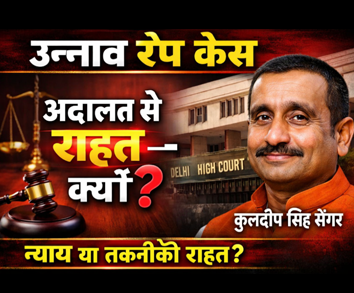
Broad Legal Explanation
By Dr. Anthony Raju, Advocate, Supreme Court of India
Leading Expert in POCSO, Rape & Dowry Death Cases
The recent decision of the Delhi High Court suspending the life sentence of Kuldeep Singh Sengar in the Unnao rape case raises grave constitutional, criminal, and human rights concerns. From a victim-centric and rule-of-law perspective, the order appears legally fragile and deeply problematic.
1. Hyper-Technical Interpretation vs. Substantive Justice
The suspension rests primarily on a narrow, textual reading that a sitting MLA does not qualify as a “public servant” under Section 21 IPC, thereby excluding the aggravated offence provisions under Section 5(c) of the POCSO Act and Section 376(2) IPC.
Even if this technical view is accepted arguendo, it does not dismantle the core finding of guilt for penetrative sexual assault of a minor under Sections 3/4 POCSO—an offence independently punishable with life imprisonment. Substantive justice cannot be eclipsed by classificatory semantics.
2. Life Imprisonment: Suspension Is an Exception, Not a Norm
Settled Supreme Court jurisprudence holds that once a person is convicted and sentenced to life imprisonment, the presumption of innocence no longer survives. Suspension of such a sentence is permissible only when a palpable, gross, and fatal error in the trial judgment is demonstrated—suggesting a high likelihood of acquittal.
Here, the High Court did not record any prima facie finding that conviction under Sections 3/4 POCSO is unsustainable. Absence of such a finding makes suspension legally untenable.
3. Ignoring Gravity of Offence and Abuse of Power
This case is not routine. It involved:
A minor victim,
Entrenched abuse of political power, and
A documented pattern of intimidation.
The survivor’s father died after custodial assault; family members faced persistent threats; the prosecution was set in motion only after extraordinary public protest; and the Supreme Court itself had to transfer the trial due to concerns about safety and fairness. Any bail or suspension analysis that sidelines these realities undermines the criminal justice system’s duty to protect the vulnerable.
4. Misplaced Reliance on “Minimum Sentence Served”
The reasoning that relief could be granted because the convict has already undergone the minimum sentence under Section 4 POCSO is deeply flawed. The statute clearly authorizes life imprisonment for penetrative sexual assault of a child. Treating the minimum as the ceiling distorts legislative intent and trivializes the offence.
5. Victim Protection Is Central to Bail Jurisprudence
Courts are bound to assess the risk to the survivor and witnesses. The history of intimidation in this case is undisputed. Dismissing such risks by presuming perfect policing ignores lived realities and contradicts binding precedent that places victim safety at the heart of sentencing and suspension decisions.
6. Constitutional Ethos and Public Confidence
Sexual offences against children implicate Article 21—the right to life with dignity. Orders that appear to dilute accountability in cases involving extreme gravity, power asymmetry, and prior obstruction of justice erode public confidence and send a dangerous message to survivors nationwide.
Conclusion
From a constitutional, statutory, and human rights standpoint, the suspension of sentence in this case reflects a hyper-technical approach divorced from ground realities. Courts must ensure that technical interpretations do not defeat the object of protective laws like POCSO, nor overshadow the gravity of offences and the lived trauma of survivors.
Justice must be seen not only in text, but in impact.
Justice cannot be reduced to wordplay when a child’s dignity, life, and safety are at stake.
Courts must ensure that law protects the vulnerable, not comforts the powerful.
#JusticeForUnnaoSurvivor
#POCSOJustice
#ChildSafetyFirst
#NoMercyForChildRapists
#LifeImprisonmentMeansLife
#RuleOfLawAbovePower