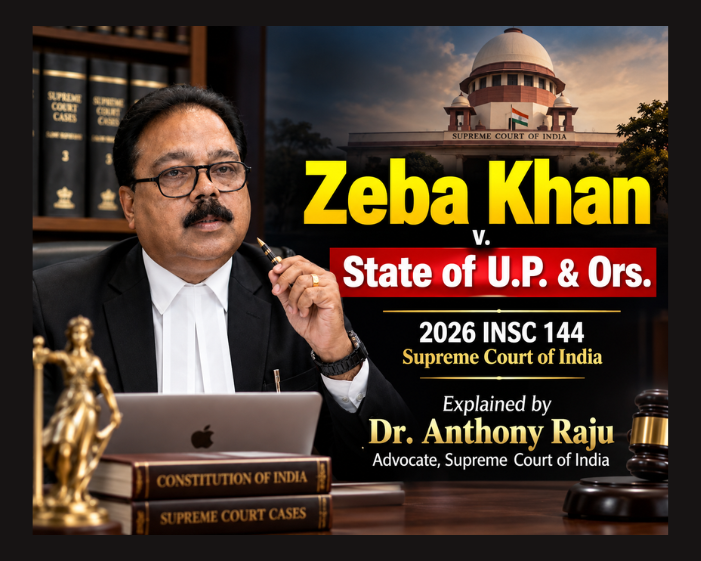
LEGAL NOTE
ZEBA KHAN v. STATE OF U.P. & ORS.
2026 INSC 144 | SUPREME COURT OF INDIA
BAIL, CRIMINAL ANTECEDENTS, SUPPRESSION OF MATERIAL FACTS AND JUDICIAL SCRUTINY OF BAIL ORDERS
SPECIAL RELEVANCE TO DOWRY DEATH CASES AND SECTION 304-B IPC
Explained by
- ANTHONY RAJU
ADVOCATE, SUPREME COURT OF INDIA
INTRODUCTION
The judgment of the Hon’ble Supreme Court in Zeba Khan v. State of U.P. & Ors., 2026 INSC 144, is an important decision concerning bail, disclosure of criminal antecedents, suppression of material facts and the circumstances in which a Superior Court may interfere with an order granting bail.
The judgment is particularly important for criminal practitioners because it highlights the distinction between cancellation of bail on account of subsequent misconduct and judicial interference with an original bail order that is legally unsustainable.
It is important to clarify that Zeba Khan itself concerned offences under Sections 419, 420, 467, 468 and 471 IPC. It was not a prosecution under Section 304-B IPC. Its relevance to dowry-death cases lies in its broader principles governing judicial discretion and scrutiny of bail orders.
- BAIL IS A JUDICIAL DISCRETION
Grant of bail involves the exercise of judicial discretion.
Personal liberty under Article 21 is fundamental, but the Court must balance liberty with the interests of a fair and effective criminal justice process.
Relevant considerations may include:
Nature and gravity of the accusation
Specific role attributed to the accused
Prima facie material
Criminal antecedents
Possibility of influencing witnesses
Possibility of tampering with evidence
Possibility of repetition of the alleged offence
Likelihood of absconding
Stage of investigation or trial
Period of custody
Interests of fair administration of criminal justice
Therefore, bail cannot be granted mechanically.
- CANCELLATION OF BAIL AND SETTING ASIDE OF A BAIL ORDER
THIS IS ONE OF THE MOST IMPORTANT DISTINCTIONS FOR CRIMINAL PRACTITIONERS.
CANCELLATION OF BAIL generally concerns subsequent conduct or supervening circumstances after bail has been granted.
Examples include:
Threatening witnesses
Tampering with evidence
Violating bail conditions
Absconding
Committing another offence
SETTING ASIDE A BAIL ORDER is different.
Where the original order granting bail suffers from serious legal infirmity, perversity, non-application of mind or failure to consider material and relevant circumstances, a Superior Court may examine the sustainability of the original order.
Therefore, the question may not always be:
“Has the accused violated bail?”
It may instead be:
“WAS THE ORIGINAL ORDER GRANTING BAIL LEGALLY SUSTAINABLE?”
- CRIMINAL ANTECEDENTS MUST BE CANDIDLY DISCLOSED
A person seeking discretionary relief from a Court must make complete and candid disclosure of material facts.
Before filing a bail application, counsel should carefully verify:
Previous FIRs
Criminal cases
Sections involved
Present status of cases
Previous bail applications
Previous bail rejection orders
Previous bail grants
Non-bailable warrants
Proclamation proceedings
Other material judicial proceedings
Suppression of a material fact can become particularly serious where the undisclosed information was capable of influencing the Court’s exercise of discretion.
- AN FIR IS NOT A CONVICTION
This principle must never be forgotten.
The existence of an FIR or criminal antecedent does not by itself establish guilt.
The Court must examine the nature, status, relevance and circumstances of the antecedent.
Therefore:
CRIMINAL ANTECEDENT IS RELEVANT.
BUT AN FIR IS NOT A CONVICTION.
Each antecedent must be considered in its proper factual and legal context.
- SPECIAL RELEVANCE TO DOWRY DEATH CASES
Dowry-death prosecutions under Section 304-B IPC involve serious allegations concerning the death of a married woman in circumstances prescribed by the statute.
In such cases, the bail court must carefully examine the statutory ingredients, the material collected during investigation, the allegations against each accused and the evidence relied upon by the prosecution.
Important questions may include:
Whether the death occurred within the statutory period after marriage
Whether the death occurred otherwise than under normal circumstances
Whether there is evidence of cruelty or harassment
Whether such cruelty or harassment was in connection with a demand for dowry
Whether the alleged cruelty or harassment was soon before the death
What specific role is attributed to each accused
What evidence supports the allegations against each accused
- SECTION 113-B OF THE EVIDENCE ACT
In cases governed by the Indian Evidence Act, 1872, Section 113-B provides a statutory presumption concerning dowry death when the foundational requirements prescribed by law are established.
The existence of the statutory presumption does not mean that every allegation automatically results in a finding of guilt.
The foundational facts and the evidence supporting them remain critically important.
Therefore, in a 304-B case, counsel must carefully examine the material relied upon by the prosecution to establish the statutory requirements.
- INDIVIDUAL ROLE OF EACH ACCUSED
One of the important practical issues in dowry-death litigation is the necessity of examining the specific role attributed to each accused.
The Court may consider:
What exactly is alleged against the accused?
Who allegedly demanded dowry?
When was the alleged demand made?
What evidence supports the allegation?
Are the allegations specific or general?
Are there material contradictions?
Are there significant omissions or improvements?
What do the earliest statements reveal?
What does the medical and post-mortem evidence establish?
What independent or corroborative material exists?
What was the accused’s actual role?
- EVIDENCE AND CROSS-EXAMINATION
SERIOUS CRIMINAL DEFENCE IS BUILT ON EVIDENCE.
A careful trial strategy may require scrutiny of:
Witness statements
Material omissions
Contradictions
Improvements
Medical evidence
Post-mortem findings
Forensic evidence
DNA evidence, where relevant
Electronic evidence
Call records and communications
Marriage-related documents
Alleged dowry transactions
Earlier complaints
Letters, messages and other documentary material
The purpose of cross-examination is not merely to ask questions.
It is to test credibility, expose inconsistencies, challenge unsupported assertions and bring material facts before the Court.
THE QUALITY OF CROSS-EXAMINATION CAN DIRECTLY AFFECT THE QUALITY OF FACT-FINDING.
- INVESTIGATION AND PROCEDURAL SAFEGUARDS
The defence should examine whether the investigation was conducted fairly and whether relevant material was properly collected, preserved and presented.
Questions may include:
Were material witnesses examined?
Were relevant documents collected?
Was electronic evidence properly handled?
Was forensic evidence properly examined?
Were material contradictions investigated?
Were mandatory procedural safeguards followed?
Was the investigation consistent with the applicable law?
- LESSON FOR DEFENCE COUNSEL
Before filing a bail application in a serious criminal case, conduct a complete CASE AUDIT.
FIR
CHARGES
CRIMINAL ANTECEDENTS
PREVIOUS BAIL APPLICATIONS
PREVIOUS ORDERS
CUSTODY STATUS
INVESTIGATION STATUS
WITNESS STATEMENTS
MEDICAL EVIDENCE
FORENSIC MATERIAL
DOCUMENTARY EVIDENCE
ELECTRONIC EVIDENCE
PROCEDURAL COMPLIANCE
LATEST BINDING PRECEDENTS
COMPLETE AND TRUTHFUL DISCLOSURE PROTECTS BOTH THE LITIGANT AND THE INTEGRITY OF THE PROCEEDINGS.
- LESSON FOR PROSECUTION AND COMPLAINANT
Where bail has already been granted, the challenge should be legally precise.
The question should not automatically be:
“THE ACCUSED HAS BEEN GRANTED BAIL.”
The more important questions may be:
What material was before the Court?
What material was ignored?
Was the specific role of the accused considered?
Were the statutory ingredients considered?
Were relevant criminal antecedents considered?
Was there proper application of mind?
Was the discretion exercised on legally relevant considerations?
If the original order is legally unsustainable, the Superior Court may examine the legality and propriety of that order.
- RELEVANCE TO POCSO AND OTHER SERIOUS CRIMINAL CASES
The principles concerning judicial discretion, disclosure of material facts, criminal antecedents and scrutiny of bail orders may have wider relevance across serious criminal litigation.
They may be considered, subject to the applicable statutory framework, in:
POCSO cases
Sexual-offence cases
Murder cases
Dowry-death cases
Economic offences
Organised crime cases
Other serious criminal proceedings
However, every special statute has its own statutory requirements.
Therefore, Zeba Khan should be used as part of the broader bail jurisprudence and not as a substitute for offence-specific precedents.
- THE PRACTITIONER’S CHECKLIST
BEFORE BAIL:
FACTS
EVIDENCE
STATUTORY INGREDIENTS
ROLE OF ACCUSED
CRIMINAL ANTECEDENTS
PREVIOUS ORDERS
CUSTODY PERIOD
INVESTIGATION STATUS
WITNESS POSITION
MEDICAL AND FORENSIC MATERIAL
PROCEDURAL COMPLIANCE
LATEST PRECEDENTS
AFTER BAIL:
READ THE COMPLETE BAIL ORDER
IDENTIFY WHAT WAS CONSIDERED
IDENTIFY WHAT WAS IGNORED
EXAMINE APPLICATION OF MIND
CHECK FOR PERVERSITY OR LEGAL INFIRMITY
SEPARATELY ASSESS ANY SUBSEQUENT MISCONDUCT
SELECT THE CORRECT LEGAL REMEDY
KEY TAKEAWAY
ZEBA KHAN TEACHES AN IMPORTANT LESSON:
BAIL IS JUDICIAL DISCRETION.
CRIMINAL ANTECEDENTS MATTER, BUT AN FIR IS NOT A CONVICTION.
MATERIAL FACTS MUST BE CANDIDLY DISCLOSED.
A VALIDLY GRANTED BAIL MAY BE CANCELED FOR SUBSEQUENT MISCONDUCT.
AN UNSUSTAINABLE ORIGINAL BAIL ORDER MAY BE OPEN TO SCRUTINY BY A SUPERIOR COURT.
AND IN A DOWRY-DEATH CASE, THE SERIOUSNESS OF THE ALLEGATION DOES NOT ELIMINATE THE REQUIREMENT OF CAREFUL JUDICIAL EXAMINATION OF THE STATUTORY INGREDIENTS, EVIDENCE AND INDIVIDUAL ROLE OF THE ACCUSED.
THE REAL QUESTION IS NOT SIMPLY:
“WHO WAS ARRESTED?”
THE REAL QUESTIONS ARE:
WHAT DOES THE LAW REQUIRE?
WHAT DOES THE EVIDENCE ESTABLISH?
WHAT MATERIAL WAS BEFORE THE COURT?
WHAT WAS CONSIDERED?
WHAT WAS IGNORED?
AND WAS JUDICIAL DISCRETION EXERCISED IN ACCORDANCE WITH LAW?
LEGAL AWARENESS NOTE
EXPLAINED BY
- ANTHONY RAJU
ADVOCATE, SUPREME COURT OF INDIA
CRIMINAL LAW PRACTITIONER | POCSO EXPERT | LEGAL SCHOLAR | AUTHOR | PUBLIC SPEAKER | VISITING LEGAL FACULTY
WhatsApp and Legal Helpline: 8588872001
Email: office@humanrightscouncil.in
DISCLAIMER
This Legal Note is intended solely for legal education and awareness and does not constitute case-specific legal advice. The application of any judgment depends upon the applicable statutory regime, date of occurrence, facts, evidence, procedural history and binding judicial precedents. Professional legal advice should be obtained before relying upon any proposition in an individual case.
#LegalNote #ZebaKhan #2026INSC144 #SupremeCourtIndia #SupremeCourtJudgment #SupremeCourtLaw #Bail #BailJurisprudence #CriminalLaw #CriminalLawyer #CriminalDefence #CriminalLitigation #CriminalAntecedents #CancellationOfBail #BailOrder #DowryDeath #Section304B #304BIPC #DowryDeathCase #498A #498ACase #DowryHarassment #CriminalAppeal #POCSO #POCSOLaw #POCSOCase #EvidenceLaw #CriminalEvidence #CrossExamination #CriminalJurisprudence #LegalAwareness #LegalEducation #YoungLawyers #LawStudents #IndianLaw #ConstitutionalLaw #Article21 #HumanRights #RuleOfLaw #Justice #DrAnthonyRaju #DrAnthonyRajuAdvocate #AdvocateSupremeCourt #SupremeCourtAdvocate
Dr Anthony Raju, Dr Anthony Raju Advocate Supreme Court, Zeba Khan v State of UP, Zeba Khan 2026 INSC 144, Supreme Court bail judgment 2026, Supreme Court bail jurisprudence, cancellation of bail Supreme Court, setting aside bail order, criminal antecedents bail, suppression of material facts bail, dowry death case bail, Section 304B IPC bail, 304B dowry death defence, 498A and 304B case, dowry death criminal law, dowry harassment case, bail in dowry death cases, criminal defence lawyer India, Supreme Court criminal advocate, POCSO bail, POCSO defence, criminal appeal lawyer, cross examination criminal cases, criminal evidence India, criminal jurisprudence India, Article 21 bail, personal liberty criminal law, legal awareness India, legal education for young lawyers, Supreme Court judgments explained, latest Supreme Court criminal law judgments, jail reforms, prisoners rights, human rights lawyer India.